 Denys Mitchell
Key Takeaways
- E3 on an Asko freezer means the evaporator fan is not running, so the cabinet warms while the evaporator stays cold.
- The freezer is not safe to keep using with E3: move the food to a backup freezer at once.
- Ice jamming the blade is the most common cause, followed by seized bearings and loose wiring.
- Ice is a symptom, so look at the door seal and the defrost circuit (E2) before the new fan is jammed again.
- In most cases the fan is worth fixing; a new fan that does not clear E3 points at the board and changes the arithmetic.
The Bottom Line
Move the food, defrost and find out why the fan stopped before you decide anything; a fan repair is almost always better value than a new freezer. The price is confirmed after diagnosis, with a written estimate before work begins.
A freezer with a cold evaporator and a warm cabinet is a machine that is making cold and not delivering it. On an Asko upright freezer, the part that moves the cold is the evaporator fan, and when it stops the control shows E3. This guide covers the Asko freezer evaporator fan fix or replace call: what usually fails, what a repair involves and when the freezer itself is the thing to weigh. It is about one part of one appliance, so for the whole-appliance question see our guide on repair or replace for an Asko refrigerator.
| Situation | Lean toward | Why |
|---|---|---|
| Ice jammed the blade, motor spins by hand | Repair | Defrost, then find out why the ice formed |
| Seized or worn motor bearings | Repair | A fan motor is a small part |
| Wiring or connector fault | Repair | The cheapest outcome |
| New fan does not clear E3 | Weigh the board repair | The motor driver circuit may have failed |
| Old freezer, high temperatures for days | Weigh replacement | Compressor or refrigerant issues may follow |
What Does E3 Mean on an Asko Freezer?
That the evaporator fan motor is not running or is drawing the wrong current. The code page says the fan sits behind the interior back panel and circulates air across the cold evaporator coils, spreading cold through the cabinet. When it stops, the evaporator at the back stays cold, the compressor can run, and the front of the freezer stays warm.
Several symptoms point the same way: a cabinet that is warm despite the compressor running, a squeal or grinding from behind the back panel as a bearing starts to seize, and thick frost on the rear wall only while the front stays warm. That last one the page calls a clear sign of fan failure.
Is It Safe to Keep Using the Freezer With E3?
No. The page is direct: without the evaporator fan the freezer cannot hold safe frozen-food temperatures, so transfer the contents to a backup freezer at once and arrange the repair. Stop and move the food immediately if the temperature is above -12°C (10°F), or if you smell burning from inside the cabinet, since a stalled motor may be overheating.
A reset does not help. The page says E3 needs the fan obstruction cleared or the motor replaced, and a reset will not start a seized or disconnected motor.
The Three Usual Causes of E3
Three things, and the first is the one to rule out. The page lists ice jamming the fan blade as the most common cause in upright freezers, then worn or seized motor bearings after years of operation, then a broken or disconnected wiring connector between the motor and the board.
- Ice around the fan blade. Frost has built up until the blade cannot turn, and the motor stalls.
- Seized bearings. The shaft no longer turns freely, even without ice.
- Loose or broken wiring. The connector or a wire has come loose or fractured and cuts power to the motor.
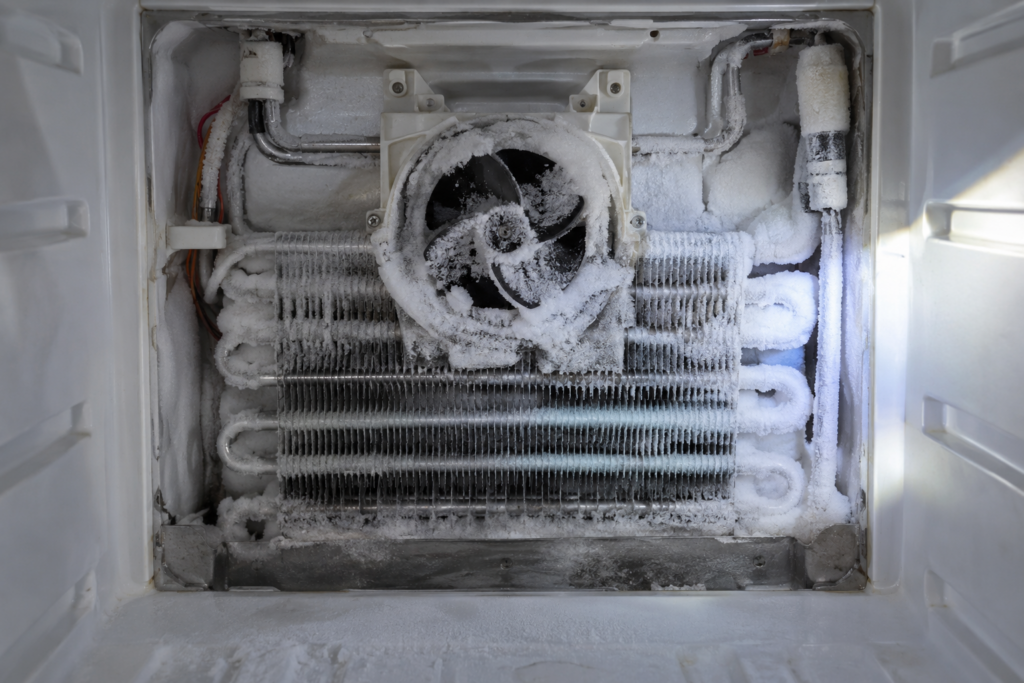
It is worth looking at why the ice formed before you replace anything. A door that does not close fully, a gasket that has lost its grip or a freezer packed so tightly that air cannot move all raise the frost load, and a fan that is cleared and refitted into the same conditions will jam again. Closing the door on a slip of paper is a quick test of the seal: if the paper pulls out without resistance, the gasket is not sealing.
The order matters for the decision. Ice is a symptom of something upstream, such as a door that does not seal or a defrost fault, and the E2 page covers that defrost circuit. A fan replaced without fixing the cause will be jammed again.
Checking the Fan Yourself
You can do the first steps if you are comfortable unplugging the freezer and removing a panel, and the code page describes them. The page gives them as safe checks, but it also says to unplug the freezer first, so never work on the fan with the power connected.
- Look for ice around the blade. With the unit unplugged, remove the interior back panel, which the page says is held by two to four screws. If there is ice, do a full manual defrost with the door open for 24 hours before restarting.
- Spin the blade by hand. It should turn freely with little drag. Stiffness, grinding or total resistance means failed bearings, and the motor needs replacing.
- Reseat the wiring connector. Disconnect it, check the pins for corrosion, reconnect firmly and listen for the fan to spin up within 30 seconds.
If you would rather not open the cabinet, leave it to a technician. Having the model number and the number printed on the fan motor housing ready saves a second visit.
What a Fan Repair Involves
A technician confirms that the fan is the fault before anything is ordered, and the visit follows a short sequence. The page puts the work at 60 to 90 minutes and rates it as not something to attempt without experience.
- Confirm the fan is not running. The evaporator is cold, the compressor runs and no air moves.
- Test the motor and the wiring. A free-spinning blade with no power points at the connector or the board, and a stiff blade points at the bearings.
- Replace the motor if needed. The part number is printed on the motor housing, and giving it to the technician saves a second visit.
- Check that E3 clears. If it does not, the board's motor driver is the next suspect.
Keep the food in the cooler until the freezer has reached its working temperature again, and measure it with a separate thermometer, not the display alone.
Should You Fix or Replace an Asko Freezer With E3?
Fix it, in most cases. The code page puts a typical repair from $170 and a visit of 60 to 90 minutes, and a fan motor is a small part compared with the freezer. A replacement freezer also means moving a full cabinet and, for an integrated unit, cabinetry work. The balance shifts only when the fan is not the whole story.
- The new fan does not clear E3. The page says the motor driver circuit on the board may have failed, which is a larger repair.
- The blade is cracked or the bracket is broken. A professional is needed to source the correct assembly.
- High temperatures for a long time. The page lists compressor or refrigerant issues as a possibility if the freezer has been warm for long.
- An old freezer with other faults. Add the estimates together before agreeing to the first one.
The final price is confirmed after the diagnosis on site, with a written estimate before any work begins. When the board is the problem, our guide on the freezer E6 system fault shows how that decision is weighed. Our freezer repair service covers the fan, the wiring and the board. Schedule a visit or contact us with the code, the temperature you measured and the model number.