 Denys Mitchell
Key Takeaways
- E4 means the compressor or condenser reached an unsafe temperature and the thermal protection has activated.
- It cannot be reset away: the overheating cause must be fixed, and the compressor needs about 30 minutes unplugged to cool.
- Cleaning the condenser, fixing clearances and checking the room temperature clear most cases and cost nothing.
- E4 that returns within a day of a thorough clean points at a refrigerant leak, a failing compressor or a fan.
- Repair a freezer that is otherwise sound; compare against replacing when the compressor has failed on an older unit.
The Bottom Line
Move the food, clean the condenser, fix the clearances and let the compressor rest before restarting. If E4 returns within a day, get a diagnosis and weigh the estimate against a new freezer.
E4 is the code an Asko upright freezer shows when its compressor or condenser has reached an unsafe temperature and the thermal protection has stepped in. It sounds like the end of a freezer, and sometimes it is, but far more often it is a dirty condenser or a freezer pushed too close to the wall. Anyone weighing an Asko upright freezer E4 repair or replace choice should therefore start with a cleaning job, because it only becomes a real question if E4 returns within a day. This guide follows that order; for the whole-appliance view, our Asko refrigerator repair or replace guide covers the combined models.
| What happens after E4 | What it points to | Leaning |
|---|---|---|
| Cleaning and a 30-minute rest clear it | A blocked condenser or poor ventilation | Keep the freezer |
| Returns after the condenser is cleaned and clearances fixed | Fan, refrigerant or compressor | Get a diagnosis |
| Compressor hums but will not start | Start relay or capacitor | Repair, a small part |
| Hot room is the cause | Installation, not the freezer | Move the freezer |
| Failing compressor on an old freezer | End of the sealed system | Weigh against replacing |
What Does E4 Mean on an Asko Upright Freezer?
E4 means the compressor or condenser reached an unsafe temperature and the thermal protection circuit has activated. The E4 page explains that the control board limits or stops the compressor run, which is why the freezer warms slowly instead of stopping dead. It rates the code high severity, says continued operation risks permanent compressor damage and tells you to move the frozen food to a backup freezer until the cause is found.
The symptoms are very distinctive. The back and base of the freezer are far hotter than the slight warmth that is normal, the temperature rises over several hours, and the compressor starts, runs for two to five minutes and cuts out, repeating every 15 to 30 minutes. If you have that short cycling pattern, you have E4 even if the display has not caught up.
Can You Reset E4 and Carry On?
No. The page says E4 requires the root overheating cause to be resolved, and that a reset will not prevent the thermal overload from tripping again. Unplugging and restarting without addressing the heat just sends the compressor back into the same overload, and each trip is a little harder on it.
The safe order is to protect the food first, then deal with the heat:
- Move the food. The page tells you to transfer it to a backup freezer until the cause is found.
- Feel the compressor area. If it is too hot to keep a hand on for more than a second, stop and do not restart it.
- Watch the cabinet temperature. The page lists a freezer above 10 degrees Fahrenheit that does not recover after cleaning as a stop signal.
- Clean, then rest, then restart. Only after the compressor has cooled.
It matters in which order you do these. The thermal overload inside the compressor needs about half an hour to cool and reset, and restarting before that makes it trip again straight away, as the page warns.
What to Try Before Deciding
Four things, all of them cheap, and the first two solve most cases. The page describes them as the safe checks.
- Clean the condenser and fix the clearances. Unplug the freezer, pull it from the wall and vacuum the dust and lint from the rear coils with a brush attachment. The page asks for at least 50 millimeters of clearance on every side and 200 millimeters above, roughly 2 inches and 8 inches.
- Let the compressor cool, then restart. Leave the freezer unplugged for 30 minutes after cleaning so the thermal overload resets.
- Check the room temperature. The page says Asko upright freezers are typically rated for an ambient of about 10 to 38 degrees Celsius, climate classes SN to T, so an uninsulated garage in summer can cause persistent E4.
- Move the freezer if the room is the problem. If the space is hotter than the rating, relocating it or improving ventilation is the repair.
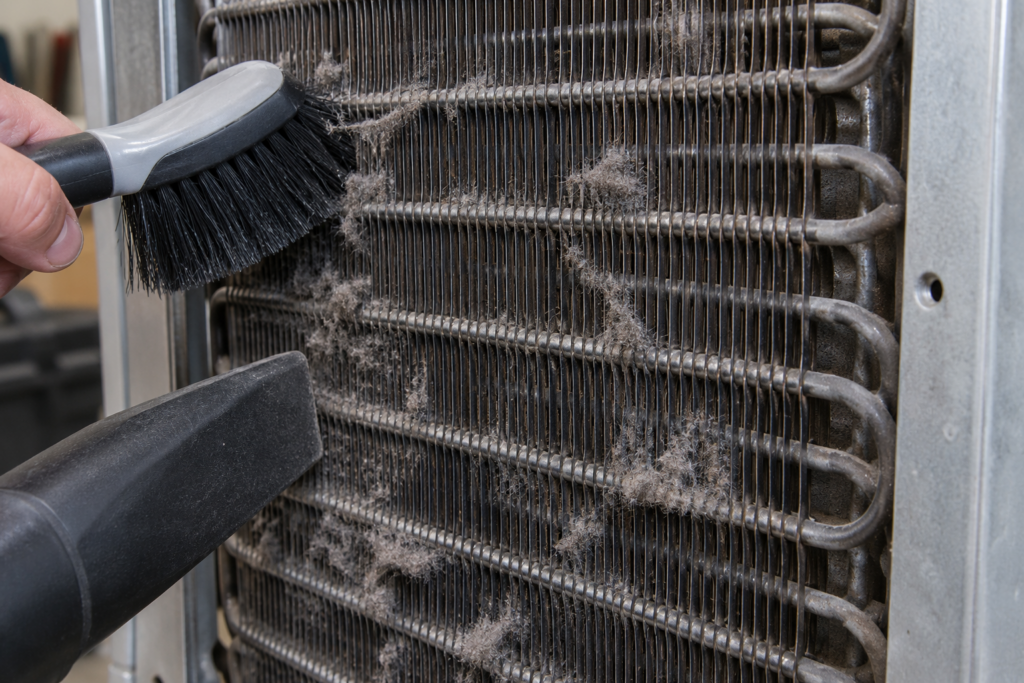
Asko recommends cleaning the condenser once a year to stop E4 recurring, particularly in dusty homes or homes with pets, according to the same page. If E6 appears instead, our guide to the Asko freezer E6 board fault covers a different failure with a different answer.
When Does E4 Point to a Repair?
When it returns within a day of a thorough clean. The page says a refrigerant leak or a failing compressor is then likely, and treats that as a job for a technician. Two other findings are more modest: a condenser fan that has stopped, which needs replacing, and a compressor that hums but does not start, which points at the start relay or capacitor, a small part with a modest labor charge.
These are different repairs with very different prices, and a good diagnosis names which one you have before you decide anything. A relay or a fan on a freezer that is otherwise sound is an easy yes. A sealed-system problem is where the age of the freezer starts to matter.
The cleaning step also doubles as evidence. If you clean the condenser, correct the clearances, rest the compressor and E4 stays away for a week, the freezer was never faulty, and no repair is needed. If it returns the next day, you have a record that the obvious causes were already dealt with, which saves the technician time and keeps the quote focused on the real fault.
When Is Replacing the Freezer the Better Answer?
When the compressor or the sealed system has failed on an older freezer, or when E4 is one of several faults. Compare the estimate with a new standalone freezer and with what the unit has already needed. The E6 guide on this site makes the same point for board faults: repair a freezer that is otherwise sound, and compare against replacement if it is already ageing elsewhere.
- A failed compressor. The most expensive cause, and the one that deserves a written comparison with a new unit.
- A refrigerant leak. A slow leak forces the compressor to overwork, and the repair costs more the longer it runs.
- A hot installation that cannot change. A new freezer in the same place faces the same overload.
- Several unrelated faults. Combined repairs approach the cost of a new one.
What to Ask in the Estimate
Ask which of the four causes was found, whether the condenser was cleaned and the clearances corrected before the compressor was blamed, and what the repair is expected to cost against a new freezer. A typical E4 repair starts from $170 on this site, with the final price confirmed after diagnosis on site and a written estimate before any work begins.
See Asko refrigerator repair costs for the wider price picture. Our freezer repair service covers the compressor circuit and its fans; schedule a visit or contact us with the code, the model and the age of the freezer.