 Denys Mitchell
Key Takeaways
- NO-HEAT on an Asko microwave means the light, turntable and timer work but the food stays cold.
- The three causes are a failed high-voltage diode, a burned-out magnetron and a faulty door interlock switch.
- On this site, a microwave over eight years old may cost more to repair than it is worth.
- Never run the microwave empty to test it, and never open the casing, because the capacitor holds a lethal charge.
- A loose or sticky door latch is the one cause a homeowner can check without internal access.
The Bottom Line
Run the water test, check the door latch and have the cause diagnosed. Fix a young built-in; weigh the estimate hard on one over eight years old.
A microwave that hums, spins and counts down but leaves the food cold is one of the easiest appliance faults to recognize and one of the hardest to value. The light works, the turntable turns, the display is fine, and yet nothing is warming. The part usually blamed is the magnetron, the tube that makes the microwaves, and because it is a high-voltage component and the appliance is often built into a cabinet, owners are quick to ask whether it is worth the trouble. This guide answers that for Asko built-in microwaves and the OCM combination ovens, using the cases this site's own pages describe.
| Situation | Usually worth fixing? | Why |
|---|---|---|
| No heat, the door latch is loose or sticky | Yes | A door fault is the one cause that needs no internal access |
| No heat on a built-in under about eight years old | Usually yes | Replacing a built-in means matching its cabinet opening |
| No heat on a microwave over eight years old | Often not | Magnetron replacement may cost more than the appliance is worth |
| A buzz, an arc or a burning smell before the heat failed | Stop first | Sparking is a safety question before it is a cost question |
| An OCM combination oven with only the microwave failed | Judge separately | The convection side may be unaffected and still worth keeping |
Is an Asko Microwave Magnetron Worth Fixing?
Yes on a built-in that is under about eight years old and otherwise sound, and often not on an older one. The no-heat code page on this site makes the cut-off explicit: if the microwave is over eight years old, magnetron replacement cost may exceed the appliance's value. A no-heat repair starts from $140 on that page, and if the magnetron itself has failed, the repair sits above that starting point, with the final price confirmed after on-site diagnosis and a written estimate before work begins.
Notice the word diagnosis. The magnetron is not the only part that causes no-heat, and it is not the likeliest. Spending money on one before the others have been ruled out is the commonest way to overpay.
What Does NO-HEAT Mean on an Asko Microwave?
It means the microwave appears to run normally, with the light on, the turntable turning and the timer counting down, while the food stays cold. The cause is somewhere in the circuit that makes the microwaves, and this site's NO-HEAT code page lists three.
- A failed high-voltage diode — the part that rectifies the transformer's output to power the magnetron. A shorted or open diode is the single most common cause.
- A burned-out magnetron — the tube degrades over its service life, and running the microwave empty speeds the process up considerably.
- A faulty door interlock switch — microwaves have two or three, and a failed one stops the magnetron circuit from energizing as a safety measure.
Two of those three are cheaper than the magnetron. That is why the first job of a technician is to find which one has failed.
How Do You Run the Water Test Safely?
Put a microwave-safe cup of water in the center, run two minutes at full power and see whether the water is warmer. If it is not, the heating circuit has failed. Never test the microwave empty, because a no-load run can permanently damage the magnetron.
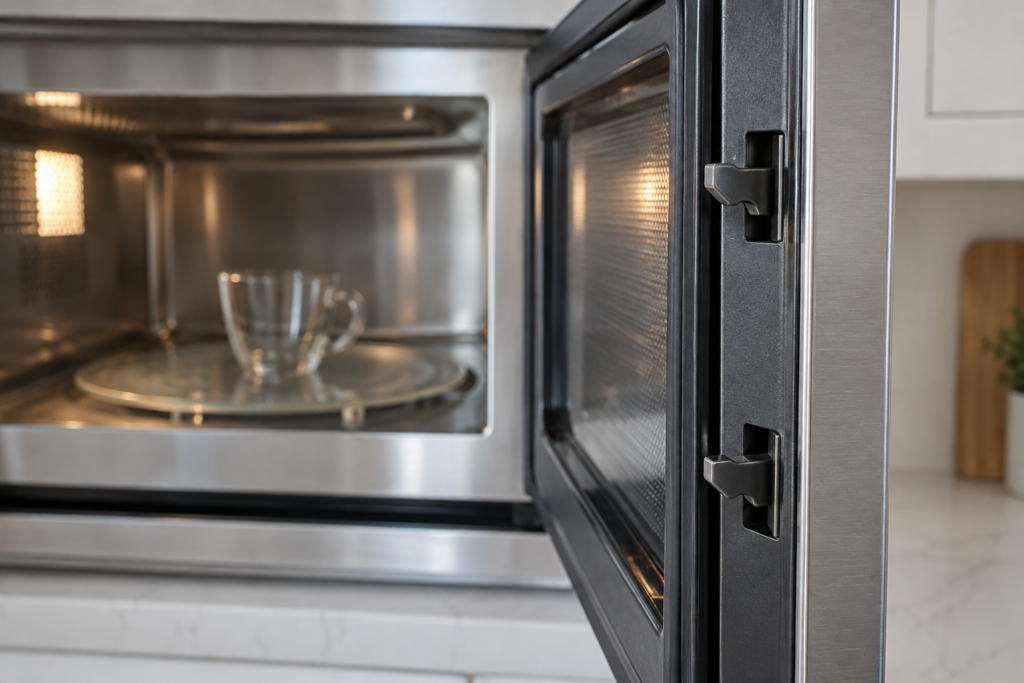
One more check needs no tools. Close the door firmly and look for a gap, a misalignment or a loose latch, then press the door gently against the frame while pressing Start. A sticky or loose latch is the one safe homeowner check that can cure a no-heat fault without any internal access.
- Do not open the casing. The internal capacitor holds a lethal charge even after the microwave is unplugged.
- Note any code on the display, such as F1, F2 or PF, and report it exactly, because it speeds the diagnosis.
- Stop at once and unplug if you notice an electrical burning smell or sparking inside the cavity.
Why Does Age Decide the Answer?
Because the repair price is much the same on an old microwave as on a young one, while the value of the appliance is not. A built-in microwave that is eight or nine years old has done most of its working life, and a repair that costs a large fraction of its replacement is hard to justify, especially if the tube itself has failed. On a young built-in the arithmetic reverses, because a replacement has to fit the cabinet opening and trim, which adds work to the price of the new appliance.
- Age of the microwave: under about eight years favors repair, over it favors replacing.
- Which part has failed: a diode or a door switch is a modest repair, while a magnetron is the part that pushes the price up.
- Warning signs before the failure: loud buzzing, arcing or a burning smell suggest the tube is breaking down and should not be used further.
- Whether it is a combination model: the convection and grill functions of an OCM unit may be sound even when the microwave side is not.
What the Technician Will Do
The microwave repair page on this site describes the order, and it is worth knowing before you book. The technician discharges the high-voltage capacitor first, as a mandatory safety step. Then the magnetron's resistance is tested and the door switches are checked, the failed part is confirmed, a written estimate is given and only then is anything replaced. The repair finishes with a test that the microwave heats and that the controls work.
The service page lists the rest of what is covered, which helps if you are comparing quotes.
- Magnetron diagnosis and replacement, after the resistance test confirms the tube has failed.
- High-voltage capacitor and diode replacement, the usual cheaper causes of a no-heat fault.
- Door switch and interlock repair, which also covers a microwave that starts and stops at once.
If the diagnosis finds the diode or a door switch, you have a modest repair. If it finds the magnetron on an old microwave, you have the information you need to decide against it.
Getting It Looked At
Be wary of anyone who quotes a magnetron replacement over the phone before testing anything. The tube is the dramatic explanation for a microwave that does not heat, and the diode is the dull one that is far more often right.
Describe the symptom exactly, say how old the microwave is and whether it is a combination model, and mention any noise or smell. Our Asko microwave repair service covers diodes, magnetrons, door switches and control boards. If the door is not latching or the cycle starts and stops at once, the door error page covers it, and for sparking see the spark page. For the combination models, our oven worth-repairing guide sets out the longer-lived side of the decision. Book a visit or send us the model, its age and what the microwave does.