 Denys Mitchell
Key Takeaways
- An F11 repair on an Asko dishwasher starts from $250 on this site, with one to two hours of professional work.
- F11 is a communication fault between the main control board and another module, usually the display board.
- A proper five-minute hard reset and a direct wall outlet cost nothing and clear power glitches.
- F11 that returns within seconds of every power-up points to a failed board or connection.
- A rinse aid dispenser fault, F12, is far cheaper, starting from $90, so the code decides the bill.
The Bottom Line
Reset the machine properly and plug it into a direct outlet first. If F11 comes back at every start, expect a diagnosis before any final price.
When an Asko dishwasher goes completely dead mid-cycle, with buttons that do nothing and an F11 on the display, the first thought is always the same: it needs a new control board, and that will cost a fortune. Sometimes it does. But F11 is a communication fault, not a verdict, and between a dead dishwasher and a board replacement there are three stages that cost very different amounts. This guide lays out what each stage costs, how to tell which one you are in, and what you can do for free before anyone books a visit.
| Stage | What happens | Cost |
|---|---|---|
| Hard reset and a direct wall outlet | You discharge the boards and remove any extension lead | No charge |
| Connector or communication fault diagnosed on site | A technician finds which link or board has failed and repairs it | from $250 |
| A new display board does not clear F11 | The main control board is the failing part and is replaced | Quoted after diagnosis |
| For comparison, a rinse aid dispenser fault (F12) | Cap, sensor or actuator is cleaned or replaced | from $90 |
What Is the Asko Dishwasher Control Board Replacement Cost?
A repair for the F11 communication fault starts from $250 on this site, and the page puts a professional repair at one to two hours. That is the entry price for diagnosing and repairing the fault, whether it turns out to be a loose harness, a failed display board or the main board. The final price is confirmed after an on-site diagnosis, with a written estimate before any work begins.
It sits at the upper end of this site's dishwasher code pages for a reason. Boards are the most expensive electronic parts in the machine, and the diagnosis has to find which of two boards is at fault. The cheaper dishwasher faults, such as a rinse aid dispenser, sit far lower.
How Do You Know It Is the Board and Not a Glitch?
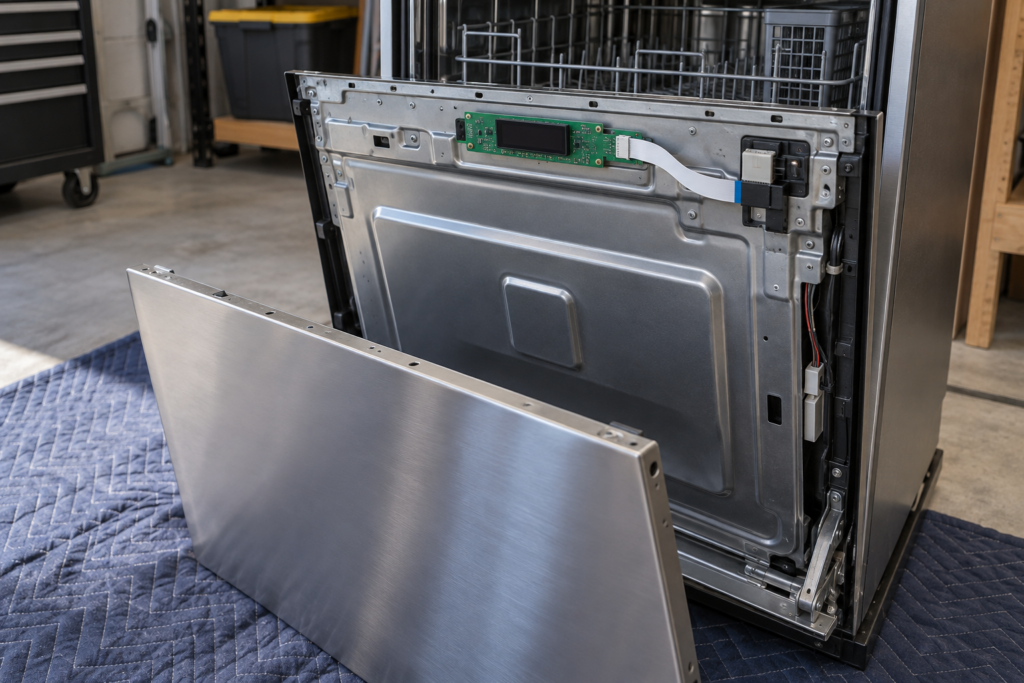
By how F11 behaves after a proper reset. This site's F11 page describes a fault in the communication between the main control board and another electronic module, typically the display board, and it separates a passing glitch from a failed board in a way you can test yourself.
- F11 clears after a five-minute hard reset and stays away: a power glitch or a brownout, not a failed board.
- F11 returns within seconds of every power-up: the board or its connection has failed.
- The display shows scrambled characters or partial segments: the display board itself is likely failing.
- The machine stops mid-cycle and cannot be restarted: the same fault met during a run, not at start-up.
The code page lists the symptoms, and they make the picture clearer than the code alone does.
- Complete unresponsiveness: every button stops working, and the cycle cannot be started, cancelled or changed.
- Mid-cycle shutdown: the cycle halts without finishing any phase, and restarting brings F11 back within seconds.
- A fault at boot: F11 shows the moment power is applied, before any cycle is chosen, which points to an electronic problem rather than a mechanical one.
- A garbled display: scrambled characters, missing segments or an erratic backlight beside the code.
The reset has to be done properly. Switch the machine off, pull the plug or switch off the breaker, wait a full five minutes so that the board capacitors discharge, restore power and then touch no buttons for thirty seconds while the boards finish starting up.
What Else Can You Check for Free?
Two more things cost nothing and are worth doing before a visit. First, check how the dishwasher is powered. The code page says Asko dishwashers should be connected to a direct, dedicated wall outlet and not an extension lead or a shared power strip, because loose connections in extension leads cause voltage fluctuations that trigger F11. Move the plug and run it again.
Second, on many D5000-series machines a factory reset clears stored fault codes and resets the communication parameters without erasing wash program settings. The page says this involves pressing and holding Start while powering on, but that the sequence differs between D5000 and DBI models, so check your model's manual and do not use a generic procedure.
What Else Ends Up on the Bill
Four things add to the starting figure, and most of them show up only at the diagnosis.
- Which board has failed. A display board and a main board are different parts at different prices, and a technician may need to replace the first to prove the second is at fault.
- Time to reach the door. A fully integrated machine behind a cabinet panel can take longer to reach, and the page allows one to two hours for the job.
- Visible damage. A burned or discolored component on the board, or water damage behind the door panel, widens the repair.
- The cause of the failure. If a power event damaged the boards, protecting the circuit is part of making the repair last.
It also helps to know why the boards fail, because the cause affects the cost of putting things right. The code page lists three: a loose inter-board connector, which a homeowner can sometimes reseat; a power supply disturbance such as a spike or brownout that knocks the boards out of step; and a failed control or display board, which needs a technician. Water ingress and age are the other routes to a dead board, and a technician will usually ask whether the machine has ever leaked.
That history matters for the estimate. A board that failed because of a leak will fail again unless the leak is stopped, so the sensible quote includes finding the source of the water, and the cost of that is part of the real price of the repair.
Is a New Control Board Worth the Cost?
On a dishwasher that is otherwise sound and not very old, yes, because the board is the single part standing between you and a working machine and the rest of the dishwasher is unaffected. It stops being worth it when the machine is old, has had other expensive repairs, or has a safety history that makes it a poor place to put money. Our worth-repairing guide for the dishwasher and the repair or replace guide set out how age and cost combine.
If your machine is an older Asko, it is also worth reading our dishwasher safety guide before you pay for a repair, since a machine with a known safety history is a different decision.
Getting a Firm Number
The quickest route to a real price is to describe F11 exactly: when it appears, what the display does and whether a reset helped. Our F11 code page lists the safe checks in order, and our dishwasher repair service replaces control and display boards and tests the wiring on the same visit. For the wider cost picture, read the dishwasher repair costs guide.
The figures above are starting points, and the final cost is confirmed after the on-site diagnosis, with a written estimate before work begins. Book a visit or send us the model and what F11 does.