 Denys Mitchell
Key Takeaways
- E2 on an Asko washer is a water fill timeout — the inlet valve opened and the drum never reached the required level in time.
- The door lock has its own codes: E9 on the washer, F8 on the dishwasher, F5 on the dryer. It is never E2.
- The lock clicking just before the failure is normal sequence, not evidence — the door has to lock before the fill starts.
- A closed tap, a kinked hose, or a limescaled mesh filter in the inlet port explain most cases and cost nothing to check.
- The same two characters mean different things on each appliance family, so read the code against the right table.
The Bottom Line
If your Asko washer stops with E2 right after the door clicks, check the tap, the inlet hose, and the mesh filter before you think about the lock. A genuine lock failure would have posted E9 instead.
A lot of people arrive here typing something close to "Asko E2 door lock error" — the door clicks shut, the program dies, and E2 is on the display, so the lock looks guilty. On an Asko washer it almost never is. The Asko E2 error is a water fill timeout, and the door lock has its own code entirely. Knowing that saves you from replacing a perfectly good latch.
| Appliance | What E2 means on it | Where the door fault actually lives |
|---|---|---|
| Washer | Water fill timeout | E9 — door lock failure |
| Dryer | Overheating trip | F5 — door switch fault |
| Dishwasher | No E2; this range uses F codes | F8 — door latch / lock fault |
| Refrigerator | Freezer sensor fault | E9 — door open or switch fault |
| Freezer | Defrost circuit fault | Not a separate code on this range |
| Cooktop | No compatible cookware | Not applicable |
Why the Door Lock Gets Blamed
The sequence fools people, and it fools them consistently. You press start, the latch clicks over with the solid sound an Asko makes, the display shows the program time, and then everything stops with E2 in the window. The last thing that happened before the failure was the lock engaging, so that is what gets remembered.
What the machine was actually doing in those seconds was filling. E2 on an Asko washer means the inlet valve was opened and the drum never reached the required level in the time allowed. The door lock did its job first and is holding exactly as designed — a locked door is a precondition for the fill, not a casualty of it.
What a Fill Timeout Looks Like
Once you know what to look for, E2 is one of the easier faults to read from the outside. The machine tells you plainly that no water arrived.
- The drum stays dry. Several minutes into the wash phase there is little or no water behind the glass.
- It stops early. The failure lands in the first few minutes, before the drum has really begun to turn.
- The valve buzzes. A faint buzz or click from the back of the machine means the solenoid is energized but nothing is flowing through it.
- The lock engages, then nothing. The latch clicks, the program freezes, and the timer stops advancing.
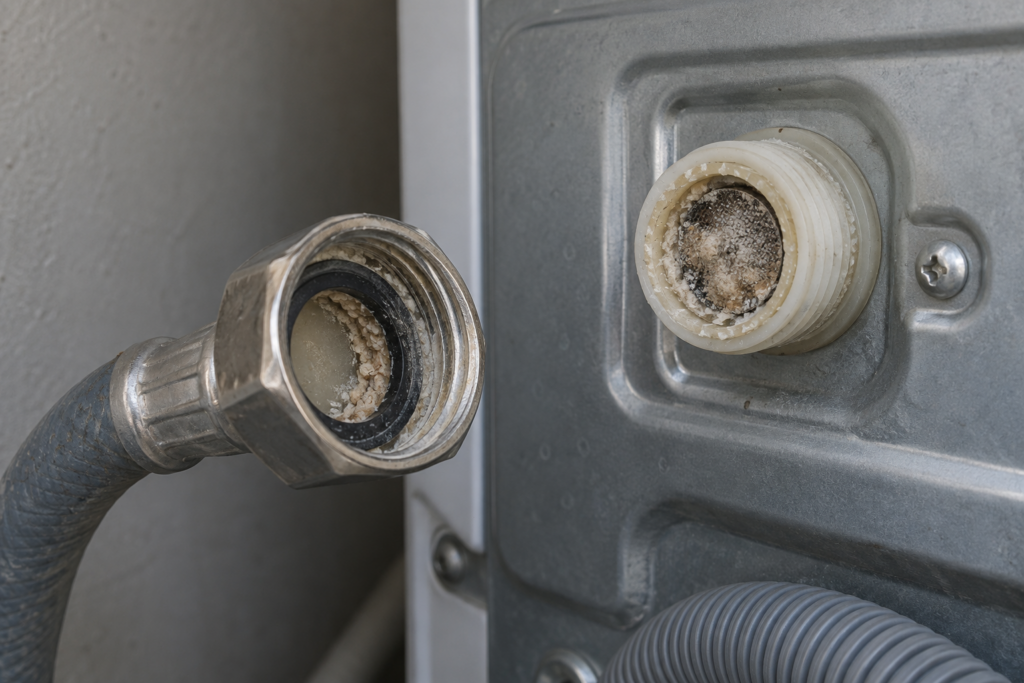
Two of those symptoms have homeowner causes. The cold-water tap behind the machine may be partly closed, or the inlet hose may be kinked against the wall — the most common finding of all, and the reason this fault turns up so often after a machine has been pulled out and pushed back. Sediment and limescale in the mesh filter inside the inlet valve are next: the filter restricts the flow to a trickle, and a trickle never satisfies the level sensor within the time window. A burnt-out solenoid coil, the third cause, is a technician's job.
The Codes That Really Are the Door
If the lock is genuinely at fault, your Asko has a code for it and will use it. On the washer that is E9, door lock failure. On the dishwasher it is F8, the door latch and lock fault. On the dryer it is F5, the door switch. None of them is E2, on any appliance in the range.
The reason the same two characters mean different things across the lineup is that each appliance family has its own code table. E2 on a refrigerator is the freezer sensor. On a freezer it is the defrost circuit. On a cooktop it means the pan you put down is not induction-compatible, which is not a fault at all. Reading a code from one appliance against another appliance's table is how good parts get replaced for nothing.
What to Check Before You Call
All of this is safe to do with the machine unplugged and the tap closed. None of it involves removing a panel.
- Open the tap fully. Behind the machine, turn the cold-water valve all the way on and confirm it is not a quarter-turn shy.
- Straighten the hose. Pull the washer forward far enough to see the whole run of the inlet hose and remove any kink or pinch against the wall.
- Clear the mesh filter. With the tap closed, unscrew the hose at the machine end and rinse the small screen in the inlet port. Limescale and grit collect there.
- Reset and watch. Power off at the wall for sixty seconds, restart a short cycle, and stay with it. If water arrives and the level rises normally, you are done.
- Stop if the hose is hot. A hot inlet hose means a cross-connection with the hot supply, which is a plumbing problem rather than an appliance one.
Do not keep restarting a washer that will not fill. Running the machine without a proper water supply puts the pump and the heating element at risk, and that turns a cheap fault into an expensive one.
When It Is Time to Book
If the tap is open, the hose is straight, the filter is clean, and E2 still appears, the fault is inside — the valve solenoid, the wiring to it, or the level sensing that decides when the fill is finished. That is where this overlaps with the drum faults covered in our guide on an Asko washer that will not spin, because both end at the same control board.
The site lists this repair from $160, and that figure covers the part and the labor rather than a guess made over the phone. The final price is confirmed after the on-site diagnosis, and a written estimate comes before any work starts. Our Asko washer repair service handles the inlet valve, the level circuit, and the door lock together, so nobody has to decide from a distance which of them it is.
Tell whoever takes the booking the exact code, whether water arrived at all, and whether the valve buzzed. Those three answers put the technician ahead before the van leaves. You can book a visit or send us the details.