 Denys Mitchell
Key Takeaways
- F12 on an Asko dishwasher is a rinse aid dispenser fault, and it is a warning that normally lets the machine finish its cycle.
- The cause is usually an empty reservoir, residue on the sensor window in the cap, or a failed sensor or actuator.
- Fill to the MAX line only, wipe spills, and set the dial to 3 or 4 for average water and 5 or 6 for very hard water.
- Overfilling causes foam that can trip the flood sensor and stop the cycle, a different fault from F12.
- If F12 persists across several cycles after cleaning, or the cap will not close, book a technician.
The Bottom Line
Refill to the MAX line, clean the sensor window and set the dosage. If F12 survives that, the sensor or actuator needs a technician.
Glasses that come out spotted, a dull film on the plastics and an F12 on the display add up to one small part: when the Asko dishwasher rinse aid dispenser cannot release rinse aid, or cannot tell whether it has any left, the final rinse stops sheeting the water off the dishes and the machine says so. The fault is gentle by the standards of dishwasher codes, because the machine usually finishes its cycle, and most of the causes can be cleared with a cup of rinse aid and a damp cloth. This guide covers how the dispenser works, why F12 can persist after a refill, the overfilling mistake that causes a different problem, and when the cap or sensor needs a technician.
| What you notice | Likely cause | What to do |
|---|---|---|
| Spots and streaks after drying, rinse aid light on | Reservoir empty | Refill and run a cycle |
| F12 at the end of each cycle after refilling | Residue on the sensor window or a sticky cap | Clean around the sensor and the cap |
| Heavy foam, a mid-cycle stop or a film on glasses | Dispenser overfilled or the dosage set too high | Wipe up spills and lower the dosage |
| Dispenser door stays shut in the rinse phase | Failed sensor or actuator | Call a technician |
How Does the Asko Dishwasher Rinse Aid Dispenser Work?
It holds a reservoir of rinse aid in the inner door and releases a measured dose into the final rinse, while a sensor in the cap watches the level. This site's F12 code page says Asko D-series and DBI-series machines use an optical or float sensor in the dispenser cap, and that F12 means the system has detected a fault in that arrangement.
Rinse aid lowers the surface tension of the water so it runs off the dishes in a sheet and dries without leaving mineral spots. Without it, drying is poor and limescale builds up on glassware. That is why an empty dispenser is a quality problem long before it is a mechanical one.
Why Is F12 Still Showing After a Refill?
Because the code reports what the sensor sees, not what you poured in. If the reservoir is full and F12 is still on the display, the likeliest explanation is residue on the sensor window or a sticky cap, which the page lists as the second cause. The third is a failed sensor or dispenser actuator, which needs a technician.
- Empty reservoir — the commonest cause. F12 usually clears by itself once the rinse aid is topped up and a cycle has run.
- Contamination on the sensor window — dried rinse aid or detergent has built up inside the cap and spoils the level reading, so the code comes and goes.
- A failed sensor or actuator — the optical sensor or the solenoid that opens the dispenser door has failed, and F12 appears whatever the level.
A dispenser cap that feels loose or sticky when you open it is a clue to the second cause, since dried rinse aid is tacky and stops the cap sealing properly.
The symptoms on the code page are worth matching against your own machine before you reach for the cloth.
- Water spots and streaks after drying — without rinse aid in the final rinse, water does not sheet off the dishes and the minerals are left behind as it evaporates.
- The rinse aid indicator lit alongside F12 — most Asko models show a dedicated warning light that comes on with the code when the reservoir is empty or the sensor faults.
- F12 logged at the end of every cycle — on some firmware versions it is recorded at the end of the rinse phase and does not halt the wash.
- A sticky or loose cap — dried residue around the opening stops the cap sealing and gives the sensor an inconsistent reading, so F12 comes and goes.
How Do You Refill the Dispenser and Set the Dosage?
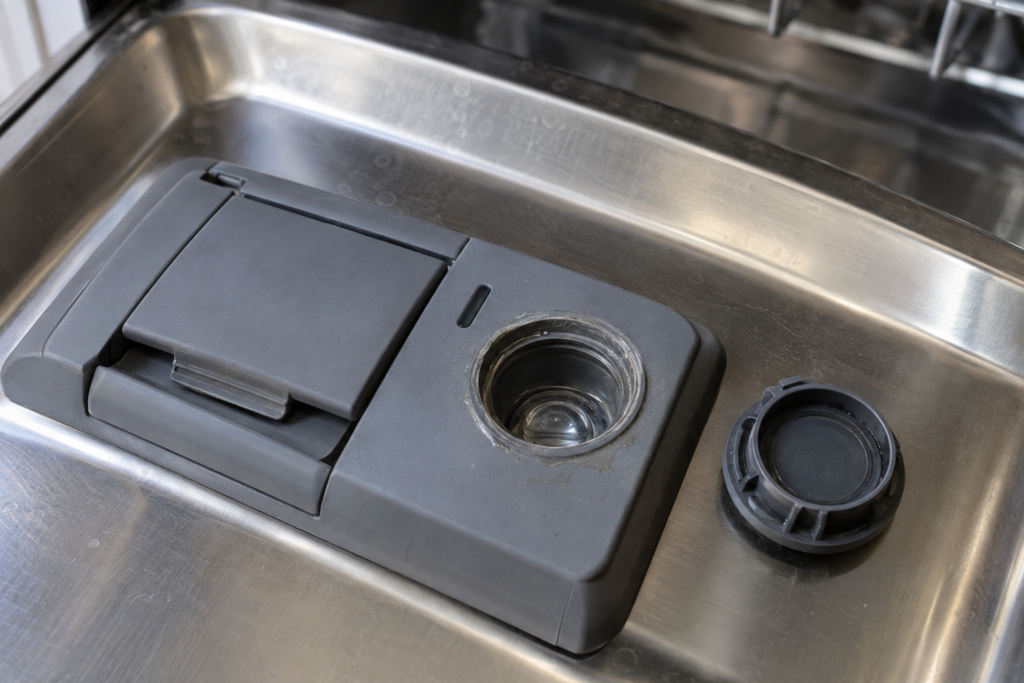
You twist off the cap, pour in rinse aid until the indicator window shows full, and set the dosage dial to suit your water. The cap sits on the inner door next to the detergent dispenser and carries a small fan or droplet symbol.
- Twist the cap open and fill slowly with ordinary dishwasher rinse aid, watching the indicator window.
- Stop at the MAX line. Do not fill to the neck of the cap, and never use liquid dish soap in its place.
- Wipe up any spill on the inner door with a damp cloth before you close it.
- Close the cap firmly, then set the dosage dial inside it to 3 or 4 for average hard water, or 5 or 6 for very hard water.
- If you use tablets that already contain rinse aid, set the dial to its minimum so the machine does not over-dispense.
Is It Safe to Keep Using the Dishwasher With F12?
Yes, for a short time, because F12 is a warning and the machine will normally complete its cycle. This site's code page rates it low severity and lists continued use as a maybe, with a clear caveat: drying will be poor and limescale will gather on glassware until you refill. Do it soon, and do not ignore a code that keeps returning.
Stop and call if F12 persists across several cycles after you have refilled and cleaned the dispenser, or if the cap will not close fully or cracks as you turn it.
What Goes Wrong When You Overfill It
Too much rinse aid is a different problem with a different symptom, and it is the usual reason a conscientious owner ends up with a worse result. The rinse aid notice on this site explains that overfilling can cause excess foam in the tub, which trips the flood protection sensor and stops the machine in mid-cycle with the dishes wet and the water undrained. The dispensers on D5000, D5900 and DBI machines hold up to 150 milliliters, and the notice says never to fill past the MAX line.
The two faults can be mistaken for each other, which is why the distinction is worth making. F12 is the machine saying the dispenser is empty or the sensor is unhappy, and it is a warning that lets the cycle finish. Overfilling is the owner doing the opposite, and its signature is a machine that stops, not one that warns.
Signs of overfilling include foam visible through the door glass, a mid-cycle stop with a water indicator lit, a slippery film on glasses and plastics, and the rinse aid light coming on right after a refill. If you see them, wipe the spill, lower the dosage and run an empty cycle before trying again. Our rinse aid overflow notice has the full routine.
When to Call a Technician
Call if the dispenser door does not open in the rinse phase even with a full reservoir, if the sensor reading is out of range with the reservoir confirmed full, or if F12 returns straight after the dispenser assembly is replaced, which points to a control board output fault. Repairs for F12 start from $90 on this site, and the final price is confirmed after an on-site diagnosis, with a written estimate before work begins.
Our F12 code page lists the safe checks in order, and the dishwasher repair service tests the dispenser, the sensor and the board on the same visit. For routine care that keeps the dispenser and filter clear, see our dishwasher maintenance guide, and if white film is a problem on its own, the water softener guide may explain it. Book a visit or send us the model and when F12 appears.