 Denys Mitchell
Key Takeaways
- F14 means the detergent dispenser did not open correctly during the wash; residue, a blocked flap path and a failed actuator are the three causes.
- Clean the dispenser flap, hinge and seal monthly with warm water, a soft brush and, for hard deposits, a vinegar mix; do not use abrasive pads.
- Keep cutting boards, baking sheets and large lids out of the swing path of the dispenser door.
- A tablet left behind or a white film on glasses means the flap is not opening on time.
- If cleaning does not help, the dispenser assembly can be replaced; the actuator can be tested by pouring detergent directly onto the tub floor for one cycle.
The Bottom Line
Check the dispenser after every wash, clean the hinge and recess monthly and keep the lower basket clear of flat items. If F14 returns after that, the actuator needs a technician.
The detergent dispenser is a small door on the inside of an Asko dishwasher that has to open at exactly the right moment in the main wash, and a few specks of caked powder can stop it. When it fails, the tablet or powder stays in one spot in the tub, dishes come out greasy or filmed and, on newer machines, F14 appears. Asko dishwasher detergent dispenser care takes five minutes a month and costs nothing, and it is the cheapest way to avoid a service call for a part that was only a cleaning away from working.
| Step | When | What it prevents |
|---|---|---|
| Check the door is open and the recess empty | After every cycle | A tablet left behind unnoticed |
| Remove caked residue with a damp cloth | Monthly | A flap that cannot open |
| Wipe the seal with white vinegar | Monthly | Mineral deposits that stick the door |
| Open and release the door by hand | Monthly | An actuator spring that has weakened |
| Keep flat items out of the swing path | Every load | A flap blocked by the load |
What Does F14 Mean on an Asko Dishwasher?
F14 means the detergent dispenser has not opened correctly during the wash cycle. The F14 page says it appears on D5000 and DBI series machines, and that the dispenser uses a solenoid-actuated bi-metal or wax-element spring mechanism to release the flap. The symptoms it lists are easy to spot:
- A tablet or powder left over. It sits undissolved at the bottom of the tub after the cycle.
- Greasy or soiled dishes. The main wash had no cleaning chemistry.
- The same point every time. The code appears at the detergent-release point in the program, which separates it from random faults.
- A stiff flap. It is sticky or needs force to open by hand.
The page lists three causes. Two are about care: detergent residue or a stuck tablet jamming the flap hinge, and a large flat item loaded in front of the dispenser that stops the flap swinging open. The third, a failed actuator solenoid or fatigued bi-metal spring, is a repair. Care addresses two out of three.
How Do You Clean the Dispenser Flap and Hinge?
With warm water, a soft brush and a little patience, once a month. Open the door and find the rectangular compartment on the inner door. Open and close the flap by hand and notice whether it is stiff. Rinse warm water over it and scrub the hinge, the inside of the flap cavity and the lip the flap closes against with a soft brush, a toothbrush works well, and dry it with a cloth.
- Use warm water and a soft cloth or brush. The detergent notice on this site says not to use abrasive pads.
- Dissolve stubborn deposits with vinegar. The F14 page suggests a 50/50 mix of white vinegar and warm water for hardened residue around the hinge, and the notice suggests wiping the seal with vinegar on a cloth.
- Confirm the flap springs open freely. It should move easily when the release button is pressed.
- Test the spring. Open and release the door by hand; it should snap shut firmly and release easily during a test cycle.
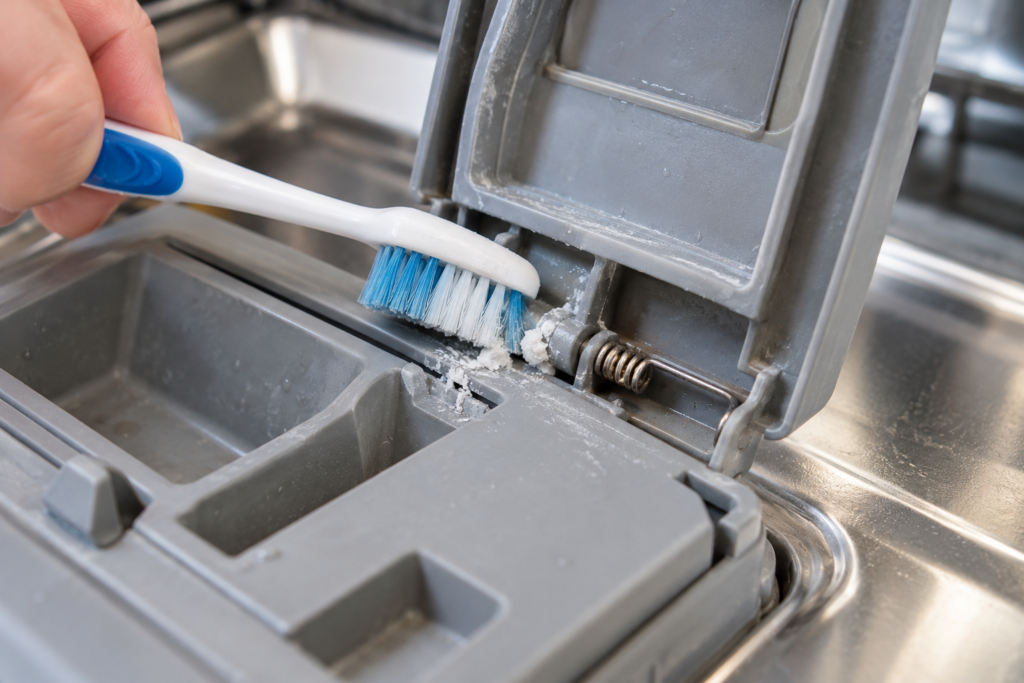
Two habits make the monthly job quicker. Do it when the machine is cool and the door has been open for a while, so the residue is dry and brushes off easily instead of smearing. And do it before you run the hot cleaning cycle from the maintenance schedule, so the loosened residue is rinsed away instead of being left in the recess for the next wash to find.
Warning Signs of a Blocked Dispenser
Four, and the first two are visible after any wash. The notice lists them:
- Detergent left in the dispenser. A tablet or partly dissolved powder remains after a completed cycle.
- A white or chalky film. It shows on glasses, especially near the bottom rack.
- A stiff door. The dispenser door feels stiff or does not open fully by hand.
- Caked detergent. It is visible in the recess or around the door seal.
The film on glasses matters more than it looks. When the flap does not open at the right point, the notice says the detergent stays concentrated in one area of the tub, which can etch glassware or leave a white residue on dark plastics, and it can leave detergent residue in contact with dishes. A wash that looks fine but leaves a film is the dispenser telling you it is not releasing on time.
How Should You Load the Lower Basket Near the Dispenser?
With nothing flat or large facing the dispenser door. The F14 page asks you to look at the lower basket with particular attention to items in front of the dispenser: cutting boards, baking sheets and large plate lids can stop the flap swinging open. Put large flat items at the sides or the rear of the lower basket, never directly facing the door interior.
It is the easiest of all the causes to fix and the most often missed, because the machine ran fine yesterday with a different load. If F14 appears on one cycle and not the next, the load is the first thing to compare.
Which Detergent Works Best in the Dispenser?
Asko-compatible tablets or powder. The detergent notice says to use compatible tablets or powder only, and warns that liquid gel can leave a sticky residue in the dispenser recess that promotes blocking. If your dishwasher has been giving trouble, switching products is the simplest experiment.
- Tablets or powder. They suit the dispenser as designed.
- Not liquid gel in the dispenser. The residue it leaves invites blocking.
- A fresh product. Powder that has taken on moisture cakes in the recess.
When the Dispenser Needs a Technician
When cleaning and loading do not restore reliable operation. The notice says a broken actuator spring or a cracked door hinge calls for replacing the complete dispenser assembly, which typically takes under half an hour. The F14 page names an actuator that tests open-circuit, a dispenser switch that does not change state and F14 persisting after a full dispenser replacement, which then points at a control board output.
A typical F14 repair starts from $100 on this site, with the final price confirmed after diagnosis on site and a written estimate before any work begins. A useful test in the meantime, from the F14 page, is to run a cycle with a small amount of liquid detergent poured directly onto the tub floor instead of in the dispenser: if the dishes come out clean and F14 stays away, the actuator is confirmed as the fault. It also lets you keep washing while you wait, since the page says cycles can run with detergent applied directly.
The rest of the routine is in our Asko dishwasher maintenance guide, and the filter is covered by Asko dishwasher filter maintenance. The detergent dispenser notice has the full warning list. Our dishwasher repair and preventive maintenance services cover the dispenser; schedule a visit or contact us with the code and the model number.