 Denys Mitchell
Key Takeaways
- E06 is the convection fan motor in the oven cavity, not a heating element and not the control board.
- An Asko oven has two fans: E06 is the convection fan inside the cavity, E04 is the cooling fan that protects the electronics.
- Conventional bake and broil usually still work with E06 showing, but fan-forced modes should be left alone.
- Do not keep selecting fan modes to free a stiff motor — a stalled motor under power burns out its own windings.
- An electrical burning smell in any mode means stop using the oven and cut the power at the breaker.
The Bottom Line
E06 points at one part, the convection fan motor, and the oven will usually still bake conventionally while you wait. What it will not survive is repeated attempts to run the fan modes anyway.
An oven that bakes fine on conventional heat but refuses every fan-forced program is not a broken element, and the display says so. The Asko oven E06 error means the convection fan motor in the back of the cavity is not turning at the speed the control board expects. Nothing is wrong with the heat itself — what has stopped is the machine that moves it around.
| What you notice | What it points to | Code | Keep using it? |
|---|---|---|---|
| Silence at the back wall in fan mode | Convection fan motor not turning | E06 | Conventional modes only |
| E06 the moment a fan program is selected | Fault confirmed on demand | E06 | Conventional modes only |
| One side of the rack browns faster | Fan running intermittently or slow | E06 | Conventional modes only |
| Electrical burning smell from the rear | Seized motor overheating its windings | E06 | No — stop all oven use |
| Controls hot, fan noise after cooking stops | Cooling fan, a different fan entirely | E04 | No — book a diagnostic |
| Oven shuts itself down mid-bake | Thermal cut-out has tripped | E08 | No — book a diagnostic |
Your Oven Has Two Fans, and They Are Not the Same
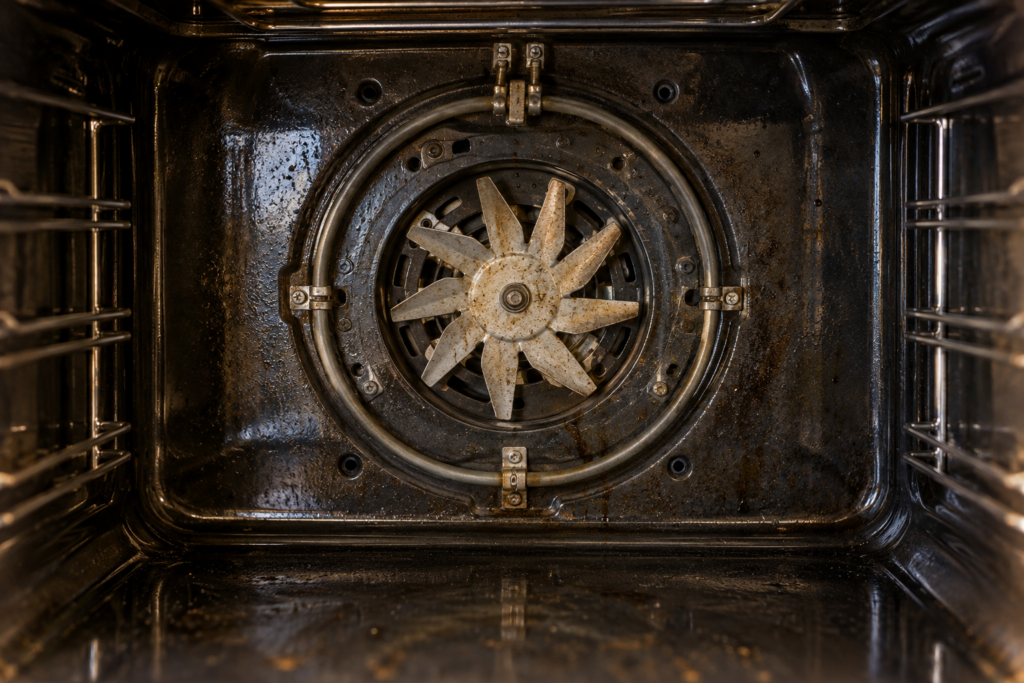
This is the distinction that decides the whole repair. The convection fan sits behind a perforated plate on the rear wall inside the cavity, usually with a ring element around it, and its job is to circulate hot air across the racks so everything cooks at the same rate. The cooling fan sits outside the cavity and pulls room air across the electronics and out through the vent in the trim, protecting the control panel from the heat of the oven it is attached to.
E06 is the convection fan. E04 is the cooling fan. Owners regularly report one and mean the other, because "the fan is not working" describes both, and a technician sent for the wrong fan arrives with the wrong part. Listen for where the sound is: cavity air you can hear through the door is convection, air moving across the control panel after the oven is switched off is cooling.
What Actually Stops the Convection Fan
The site lists three causes, and they are not equally likely or equally serious.
- Seized motor bearings. Years of heat cycling degrade the bearings until the motor stalls. It then draws high current, which is what triggers the fault — and what will burn out the windings if you keep trying.
- A blade obstruction. A rack pushed too far back, or a utensil that fell behind the shelf, can rest against the fan guard and stop the blade. This one is worth a look before anything else.
- A relay or wiring fault. If the blade turns freely by hand but the motor never runs under power, the supply relay on the control board or the harness to the motor has failed.
There is one thing not to do, and it is the instinct almost everybody has: do not keep selecting fan modes to try to free a stiff motor. A stalled motor under power heats its own windings, and repeating the attempt is how a fan motor replacement turns into a fan motor plus a control board.
Can You Keep Cooking With It?
Partly, and that qualification matters. Conventional bake and broil modes do not depend on the convection fan, and on most machines they will still run normally with E06 showing. Fan-forced bake, convection roast, and any multi-zone program should be left alone while the fault is active, because selecting them puts power back into a motor that cannot turn.
The exception overrides everything else. If you notice an electrical burning smell during any cooking mode — not only the fan modes — stop using the oven entirely and cut the power at the breaker. That smell means the motor windings are already overheating, and the wiring behind the rear wall is in the same compartment.
Recipe times will not transfer, either. Fan-forced cooking distributes heat evenly at a lower temperature, so falling back to conventional bake means longer times, more rotation of trays, and results that are not quite what you are used to. Treat it as a workaround for a week, not as a way to live with the oven.
A 6 on a Different Asko Appliance
The number on its own carries no meaning across the range, which is worth knowing if you are searching from memory rather than from the display. On this site's code tables, refrigerator E6 is the condenser fan, freezer E6 is a system or PCB fault, and cooktop E6 is a supply voltage fault. The washer range documented here has no code 6 at all, in either the E or the F family — so a 6 remembered from a laundry appliance is almost certainly a misread digit.
Oven codes also carry a leading zero: E06, not E6. If you are comparing what you saw against a list, match the format as well as the number.
What the Repair Involves
The convection fan motor is reached from the back of the oven, which means pulling the appliance out of its housing and removing the rear panel, with the cavity insulation and the mains connections in the way. The site marks this one as not homeowner work, and the reason is that compartment rather than the part itself.
Asko oven E06 repairs start from $180 on this site, with typical work taking between one and two hours. The final price is confirmed after the on-site diagnosis, and you get a written estimate before any work begins. Our Asko oven repair service covers the convection fan, the cooling fan, the elements and the control board, so the diagnosis does not depend on guessing which one it is from a phone call.
If your complaint is uneven browning rather than a code, start with our guide on an Asko oven that is not heating evenly — an intermittently slow fan produces exactly that before it ever posts E06. And if the oven has been shutting itself down mid-bake, E08, the thermal cut-out, is a different and more urgent conversation. Either way you can book a visit or send us the details first.